What Is the First Word That a Baby Says World Wide



A global map of the Spider web Index for countries in 2014
The World Wide Spider web (WWW), usually known every bit the Spider web, was originally a hypertext document management system[1] accessed over the Internet.[ii] Information technology has since evolved into the World's dominant software platform.[iii]
The resources of the Spider web are transferred via the Hypertext Transfer Protocol (HTTP), may be accessed by users by a software application called a web browser, and are published past a software application called a spider web server.
Web resource may be any type of downloaded media, but web pages are hypertext documents formatted in Hypertext Markup Language (HTML).[iv] Special HTML syntax displays embedded hyperlinks with URLs, which permits users to navigate to other spider web resources. In addition to text, spider web pages may incorporate references to images, video, sound, and software components, which are either displayed or internally executed in the user's web browser to render pages or streams of multimedia content.
Multiple web resource with a common theme and unremarkably a common domain name make upwardly a website. Websites are stored in computers that are running a web server, which is a programme that responds to requests fabricated over the Cyberspace from web browsers running on a user's estimator. Website content can exist provided by a publisher or interactively from user-generated content. Websites are provided for a myriad of informative, entertainment, commercial, and governmental reasons.
History [edit]
In 1990, Tim Berners-Lee adult the foundation for the Web- HTTP, HTML, a browser, a server, and the first website in order to manage documentation at CERN.[one]
While the Web was a success at CERN, it was non very popular elsewhere. In two years, there were only 50 websites.[5]
After the NCSA released Mosaic, a graphical browser that could display inline images[6] and submit forms,[7] and HTTPd, a server that could process forms (run across CGI), the Web became very popular with thousands of websites springing up in less than a year.[8]
In 1994, Marc Andreessen and Jim Clark founded Netscape and released Navigator which introduced Java and Javascript to the Spider web. It quickly became the ascendant browser. In 1995, Netscape had a very successful IPO which triggered a frenzy for the Web and started the dot-com bubble.[9]
Microsoft responded past developing their own browser, Internet Explorer. By bundling it with Windows, it became the ascendant browser for 14 years.[x]
Tim Berners-Lee founded the World wide web Consortium (W3C) which created XML in 1996 and recommended replacing HTML with stricter XHTML.[11]
In the concurrently, developers began exploiting an IE feature chosen XMLHttpRequest to make Ajax applications and launched the Web 2.0 revolution.
Mozilla, Opera, and Apple rejected XHTML and created the WHATWG which developed HTML5.[12]
In 2009, the W3C conceded and abandoned XHTML[13] and in 2019, ceded command of the HTML specification to the WHATWG.[14]
Function [edit]

The Www functions every bit an application layer protocol that is run "on top of" (figuratively) the Internet, helping to brand it more functional. The advent of the Mosaic spider web browser helped to make the web much more usable, to include the display of images and moving images (GIFs).
The terms Internet and Www are often used without much stardom. Still, the 2 terms do non mean the aforementioned matter. The Internet is a global arrangement of computer networks interconnected through telecommunications and optical networking. In dissimilarity, the Www is a global collection of documents and other resources, linked by hyperlinks and URIs. Spider web resources are accessed using HTTP or HTTPS, which are application-level Internet protocols that use the Internet's transport protocols.[15]
Viewing a web page on the Www usually begins either by typing the URL of the page into a web browser or past following a hyperlink to that page or resource. The web browser and so initiates a serial of background communication messages to fetch and brandish the requested page. In the 1990s, using a browser to view spider web pages—and to move from 1 web folio to some other through hyperlinks—came to be known as 'browsing,' 'spider web surfing' (later aqueduct surfing), or 'navigating the Spider web'. Early studies of this new behavior investigated user patterns in using web browsers. One report, for example, found five user patterns: exploratory surfing, window surfing, evolved surfing, bounded navigation and targeted navigation.[16]
The following example demonstrates the operation of a web browser when accessing a folio at the URL http://case.org/habitation.html. The browser resolves the server proper name of the URL (example.org) into an Internet Protocol address using the globally distributed Domain Proper noun System (DNS). This lookup returns an IP accost such as 203.0.113.4 or 2001:db8:2e::7334. The browser then requests the resources by sending an HTTP asking across the Internet to the computer at that address. It requests service from a specific TCP port number that is well known for the HTTP service and so that the receiving host tin distinguish an HTTP request from other network protocols it may exist servicing. HTTP usually uses port number 80 and for HTTPS it ordinarily uses port number 443. The content of the HTTP asking can be as unproblematic every bit two lines of text:
Go /home.html HTTP / one.1 Host : instance.org The calculator receiving the HTTP request delivers it to web server software listening for requests on port fourscore. If the webserver can fulfill the request it sends an HTTP response dorsum to the browser indicating success:
HTTP / one.1 200 OK Content-Type : text/html; charset=UTF-8 followed by the content of the requested folio. Hypertext Markup Linguistic communication (HTML) for a bones spider web page might look like this:
< html > < head > < title >Example.org – The Globe Wide Web</ title > </ head > < body > < p >The World Wide Web, abbreviated every bit World wide web and commonly known ...</ p > </ body > </ html > The web browser parses the HTML and interprets the markup ( < championship > , < p > for paragraph, and such) that surrounds the words to format the text on the screen. Many web pages employ HTML to reference the URLs of other resources such as images, other embedded media, scripts that bear on page behaviour, and Cascading Mode Sheets that bear upon page layout. The browser makes boosted HTTP requests to the web server for these other Internet media types. As it receives their content from the web server, the browser progressively renders the page onto the screen as specified by its HTML and these additional resources.
HTML [edit]
Hypertext Markup Linguistic communication (HTML) is the standard markup language for creating web pages and web applications. With Cascading Way Sheets (CSS) and JavaScript, it forms a triad of cornerstone technologies for the Earth Broad Web.[17]
Web browsers receive HTML documents from a web server or from local storage and return the documents into multimedia web pages. HTML describes the structure of a web page semantically and originally included cues for the appearance of the document.
HTML elements are the building blocks of HTML pages. With HTML constructs, images and other objects such as interactive forms may be embedded into the rendered page. HTML provides a means to create structured documents by denoting structural semantics for text such as headings, paragraphs, lists, links, quotes and other items. HTML elements are delineated by tags, written using angle brackets. Tags such as < img /> and < input /> directly innovate content into the page. Other tags such every bit < p > environs and provide information virtually certificate text and may include other tags as sub-elements. Browsers exercise not display the HTML tags, only use them to interpret the content of the folio.
HTML can embed programs written in a scripting language such as JavaScript, which affects the behavior and content of web pages. Inclusion of CSS defines the look and layout of content. The World Broad Web Consortium (W3C), maintainer of both the HTML and the CSS standards, has encouraged the use of CSS over explicit presentational HTML since 1997.[update] [18]
Linking [edit]
Virtually spider web pages contain hyperlinks to other related pages and maybe to downloadable files, source documents, definitions and other web resource. In the underlying HTML, a hyperlink looks like this: < a href = "http://example.org/dwelling.html" >Example.org Homepage</ a >
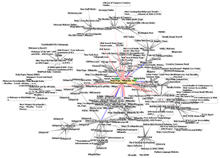
Graphic representation of a minute fraction of the Www, demonstrating hyperlinks
Such a collection of useful, related resource, interconnected via hypertext links is dubbed a web of data. Publication on the Internet created what Tim Berners-Lee first called the WorldWideWeb (in its original CamelCase, which was subsequently discarded) in November 1990.[19]
The hyperlink structure of the web is described by the webgraph: the nodes of the web graph correspond to the web pages (or URLs) the directed edges between them to the hyperlinks. Over time, many web resource pointed to past hyperlinks disappear, relocate, or are replaced with dissimilar content. This makes hyperlinks obsolete, a miracle referred to in some circles as link rot, and the hyperlinks afflicted by it are often called dead links. The ephemeral nature of the Web has prompted many efforts to archive websites. The Internet Archive, agile since 1996, is the best known of such efforts.
WWW prefix [edit]
Many hostnames used for the Www begin with www considering of the long-standing exercise of naming Net hosts according to the services they provide. The hostname of a spider web server is frequently www, in the same way that information technology may be ftp for an FTP server, and news or nntp for a Usenet news server. These hostnames appear as Domain Name System (DNS) or subdomain names, every bit in www.case.com. The apply of www is not required by any technical or policy standard and many web sites do not employ it; the first web server was nxoc01.cern.ch.[20] According to Paolo Palazzi,[21] who worked at CERN along with Tim Berners-Lee, the popular use of www as subdomain was adventitious; the World Broad Web project folio was intended to exist published at www.cern.ch while info.cern.ch was intended to be the CERN home folio; withal the DNS records were never switched, and the practise of prepending www to an institution's website domain name was subsequently copied. Many established websites however use the prefix, or they employ other subdomain names such as www2, secure or en for special purposes. Many such web servers are ready up so that both the main domain name (eastward.1000., example.com) and the www subdomain (e.chiliad., www.example.com) refer to the same site; others crave ane form or the other, or they may map to different web sites. The use of a subdomain name is useful for load balancing incoming spider web traffic by creating a CNAME record that points to a cluster of web servers. Since, currently, only a subdomain tin can be used in a CNAME, the same event cannot be achieved by using the bare domain root.[22] [ dubious ]
When a user submits an incomplete domain name to a spider web browser in its address bar input field, some web browsers automatically try adding the prefix "www" to the beginning of information technology and possibly ".com", ".org" and ".internet" at the end, depending on what might be missing. For example, entering "microsoft" may be transformed to http://www.microsoft.com/ and "openoffice" to http://www.openoffice.org. This feature started appearing in early versions of Firefox, when it nevertheless had the working title 'Firebird' in early 2003, from an earlier practice in browsers such as Lynx.[23] [ unreliable source? ] It is reported that Microsoft was granted a US patent for the aforementioned idea in 2008, only only for mobile devices.[24]
In English, www is usually read as double-u double-u double-u.[25] Some users pronounce it dub-dub-dub, particularly in New Zealand. Stephen Fry, in his "Podgrams" series of podcasts, pronounces it wuh wuh wuh.[26] The English writer Douglas Adams once quipped in The Independent on Sunday (1999): "The World Broad Web is the merely affair I know of whose shortened course takes 3 times longer to say than what information technology's short for".[27] In Mandarin Chinese, World wide web is commonly translated via a phono-semantic matching to wàn wéi wǎng ( 万维网 ), which satisfies www and literally means "myriad-dimensional net",[28] [ improve source needed ] a translation that reflects the design concept and proliferation of the World wide web. Tim Berners-Lee'southward spider web-space states that World wide web is officially spelled as 3 separate words, each capitalised, with no intervening hyphens.[29] Apply of the www prefix has been declining, peculiarly when Spider web 2.0 web applications sought to make their domain names and make them easily pronounceable.[30] As the mobile Web grew in popularity, services similar Gmail.com, Outlook.com, Myspace.com, Facebook.com and Twitter.com are most often mentioned without adding "www." (or, indeed, ".com") to the domain.
Scheme specifiers [edit]
The scheme specifiers http:// and https:// at the start of a web URI refer to Hypertext Transfer Protocol or HTTP Secure, respectively. They specify the communication protocol to use for the request and response. The HTTP protocol is fundamental to the operation of the World wide web, and the added encryption layer in HTTPS is essential when browsers send or recall confidential data, such as passwords or banking data. Web browsers usually automatically prepend http:// to user-entered URIs, if omitted.
Pages [edit]
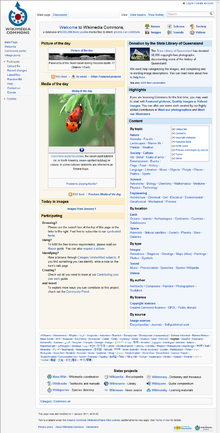
A screenshot of a web page on Wikimedia Commons
A web folio (also written as webpage) is a document that is suitable for the Www and web browsers. A web browser displays a web page on a monitor or mobile device.
The term web page ordinarily refers to what is visible, but may too refer to the contents of the computer file itself, which is usually a text file containing hypertext written in HTML or a comparable markup language. Typical web pages provide hypertext for browsing to other web pages via hyperlinks, often referred to equally links. Web browsers will frequently have to access multiple web resource elements, such as reading style sheets, scripts, and images, while presenting each web page.
On a network, a spider web browser can retrieve a web folio from a remote web server. The spider web server may restrict admission to a private network such as a corporate intranet. The web browser uses the Hypertext Transfer Protocol (HTTP) to make such requests to the web server.
A static spider web page is delivered exactly every bit stored, equally web content in the web server'southward file organization. In contrast, a dynamic web page is generated past a spider web application, ordinarily driven by server-side software. Dynamic spider web pages are used when each user may require completely different information, for instance, banking concern websites, spider web email etc.
Static page [edit]
A static web page (sometimes called a flat page/stationary page) is a web page that is delivered to the user exactly as stored, in contrast to dynamic web pages which are generated by a web application.
Consequently, a static web page displays the same information for all users, from all contexts, subject to modernistic capabilities of a web server to negotiate content-type or language of the document where such versions are available and the server is configured to practise so.
Dynamic pages [edit]
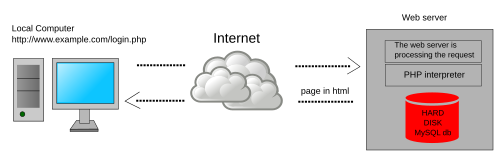
Dynamic spider web page: instance of server-side scripting (PHP and MySQL)
A server-side dynamic spider web page is a spider web folio whose structure is controlled past an application server processing server-side scripts. In server-side scripting, parameters determine how the assembly of every new web page proceeds, including the setting upwards of more client-side processing.
A client-side dynamic web folio processes the spider web folio using JavaScript running in the browser. JavaScript programs can interact with the document via Certificate Object Model, or DOM, to query page land and alter it. The same customer-side techniques can then dynamically update or modify the DOM in the aforementioned mode.
A dynamic web page is and so reloaded by the user or by a estimator program to change some variable content. The updating information could come from the server, or from changes made to that folio's DOM. This may or may not truncate the browsing history or create a saved version to go back to, but a dynamic web page update using Ajax technologies volition neither create a folio to go back to nor truncate the web browsing history forward of the displayed folio. Using Ajax technologies the end user gets i dynamic folio managed as a single page in the spider web browser while the actual web content rendered on that folio tin can vary. The Ajax engine sits simply on the browser requesting parts of its DOM, the DOM, for its client, from an awarding server.
Dynamic HTML, or DHTML, is the umbrella term for technologies and methods used to create web pages that are not static web pages, though information technology has fallen out of common use since the popularization of AJAX, a term which is now itself rarely used.[ citation needed ] Customer-side-scripting, server-side scripting, or a combination of these make for the dynamic web experience in a browser.
JavaScript is a scripting language that was initially developed in 1995 past Brendan Eich, then of Netscape, for use within web pages.[31] The standardised version is ECMAScript.[31] To make web pages more than interactive, some spider web applications as well use JavaScript techniques such as Ajax (asynchronous JavaScript and XML). Client-side script is delivered with the page that can make additional HTTP requests to the server, either in response to user deportment such as mouse movements or clicks, or based on elapsed fourth dimension. The server's responses are used to alter the electric current page rather than creating a new page with each response, and then the server needs only to provide limited, incremental data. Multiple Ajax requests tin exist handled at the same fourth dimension, and users tin interact with the page while data is retrieved. Spider web pages may also regularly poll the server to check whether new information is available.[32]
Website [edit]
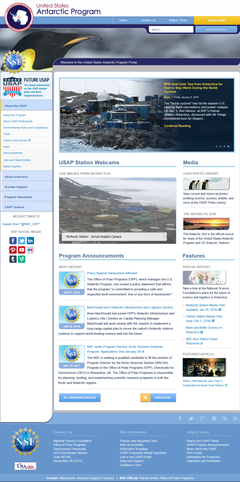
A website [33] is a collection of related web resources including web pages, multimedia content, typically identified with a mutual domain name, and published on at least i spider web server. Notable examples are wikipedia.org, google.com, and amazon.com.
A website may be accessible via a public Internet Protocol (IP) network, such as the Cyberspace, or a private local surface area network (LAN), by referencing a compatible resources locator (URL) that identifies the site.
Websites can have many functions and can be used in various fashions; a website can be a personal website, a corporate website for a visitor, a government website, an organization website, etc. Websites are typically dedicated to a particular topic or purpose, ranging from entertainment and social networking to providing news and education. All publicly accessible websites collectively constitute the Www, while private websites, such as a visitor'south website for its employees, are typically a part of an intranet.
Web pages, which are the building blocks of websites, are documents, typically equanimous in plain text interspersed with formatting instructions of Hypertext Markup Language (HTML, XHTML). They may incorporate elements from other websites with suitable markup anchors. Web pages are accessed and transported with the Hypertext Transfer Protocol (HTTP), which may optionally use encryption (HTTP Secure, HTTPS) to provide security and privacy for the user. The user's awarding, frequently a web browser, renders the page content according to its HTML markup instructions onto a brandish terminal.
Hyperlinking between web pages conveys to the reader the site construction and guides the navigation of the site, which frequently starts with a domicile page containing a directory of the site web content. Some websites require user registration or subscription to access content. Examples of subscription websites include many concern sites, news websites, academic journal websites, gaming websites, file-sharing websites, message boards, web-based email, social networking websites, websites providing existent-time stock market place information, likewise as sites providing various other services. Finish users tin access websites on a range of devices, including desktop and laptop computers, tablet computers, smartphones and smart TVs.
Browser [edit]
A web browser (commonly referred to every bit a browser) is a software user agent for accessing information on the World wide web. To connect to a website's server and brandish its pages, a user needs to accept a spider web browser program. This is the program that the user runs to download, format, and brandish a web folio on the user's computer.
In addition to allowing users to notice, display, and move between web pages, a web browser will usually accept features like keeping bookmarks, recording history, managing cookies (see below), and habitation pages and may have facilities for recording passwords for logging into web sites.
The most pop browsers are Chrome, Firefox, Safari, Internet Explorer, and Edge.
Server [edit]

A Spider web server is server software, or hardware defended to running said software, that can satisfy World wide web customer requests. A web server can, in general, contain 1 or more websites. A web server processes incoming network requests over HTTP and several other related protocols.
The main role of a web server is to store, procedure and evangelize web pages to clients.[34] The communication betwixt client and server takes identify using the Hypertext Transfer Protocol (HTTP). Pages delivered are nearly frequently HTML documents, which may include images, style sheets and scripts in addition to the text content.

Multiple spider web servers may exist used for a loftier traffic website; here, Dell servers are installed together to exist used for the Wikimedia Foundation.
A user amanuensis, commonly a spider web browser or web crawler, initiates communication by making a request for a specific resource using HTTP and the server responds with the content of that resource or an mistake bulletin if unable to practice and then. The resource is typically a real file on the server'south secondary storage, simply this is not necessarily the case and depends on how the webserver is implemented.
While the primary function is to serve content, full implementation of HTTP also includes ways of receiving content from clients. This feature is used for submitting web forms, including uploading of files.
Many generic web servers also support server-side scripting using Active Server Pages (ASP), PHP (Hypertext Preprocessor), or other scripting languages. This means that the behavior of the webserver tin exist scripted in split up files, while the actual server software remains unchanged. Usually, this function is used to generate HTML documents dynamically ("on-the-fly") as opposed to returning static documents. The former is primarily used for retrieving or modifying information from databases. The latter is typically much faster and more hands cached but cannot deliver dynamic content.
Web servers can also frequently be establish embedded in devices such as printers, routers, webcams and serving only a local network. The web server may then be used as a function of a system for monitoring or administering the device in question. This commonly means that no additional software has to be installed on the client computer since only a web browser is required (which now is included with most operating systems).
Cookie [edit]
An HTTP cookie (too chosen web cookie, Internet cookie, browser cookie, or merely cookie) is a small slice of information sent from a website and stored on the user's computer by the user's web browser while the user is browsing. Cookies were designed to exist a reliable machinery for websites to call up stateful information (such as items added in the shopping cart in an online shop) or to tape the user's browsing activity (including clicking particular buttons, logging in, or recording which pages were visited in the past). They tin can besides be used to remember arbitrary pieces of information that the user previously entered into form fields such every bit names, addresses, passwords, and credit card numbers.
Cookies perform essential functions in the modern web. Perhaps most importantly, authentication cookies are the most common method used by web servers to know whether the user is logged in or non, and which account they are logged in with. Without such a mechanism, the site would not know whether to send a folio containing sensitive data or require the user to authenticate themselves by logging in. The security of an hallmark cookie mostly depends on the security of the issuing website and the user's web browser, and on whether the cookie data is encrypted. Security vulnerabilities may allow a cookie'due south data to be read by a hacker, used to proceeds access to user data, or used to gain access (with the user'due south credentials) to the website to which the cookie belongs (see cantankerous-site scripting and cross-site request forgery for examples).[35]
Tracking cookies, and especially tertiary-party tracking cookies, are commonly used every bit means to compile long-term records of individuals' browsing histories – a potential privacy concern that prompted European[36] and U.S. lawmakers to take action in 2011.[37] [38] European police force requires that all websites targeting European Marriage member states gain "informed consent" from users before storing non-essential cookies on their device.
Google Projection Naught researcher Jann Horn describes ways cookies can be read by intermediaries, like Wi-Fi hotspot providers. He recommends using the browser in incognito way in such circumstances.[39]
Search engine [edit]

The results of a search for the term "lunar eclipse" in a web-based epitome search engine
A web search engine or Cyberspace search engine is a software system that is designed to acquit out web search (Internet search), which means to search the World wide web in a systematic mode for detail data specified in a web search query. The search results are more often than not presented in a line of results, oftentimes referred to equally search engine results pages (SERPs). The information may exist a mix of spider web pages, images, videos, infographics, articles, research papers, and other types of files. Some search engines also mine information available in databases or open directories. Unlike spider web directories, which are maintained only by human editors, search engines also maintain real-time information by running an algorithm on a spider web crawler. Internet content that is not capable of being searched past a web search engine is generally described equally the deep web.
Deep web [edit]
The deep web,[40] invisible web,[41] or hidden spider web [42] are parts of the Www whose contents are not indexed past standard web search engines. The opposite term to the deep web is the surface web, which is accessible to anyone using the Internet.[43] Computer scientist Michael K. Bergman is credited with coining the term deep web in 2001 as a search indexing term.[44]
The content of the deep web is hidden behind HTTP forms,[45] [46] and includes many very common uses such as web mail service, online cyberbanking, and services that users must pay for, and which is protected by a paywall, such equally video on demand, some online magazines and newspapers, among others.
The content of the deep web tin be located and accessed by a direct URL or IP accost, and may require a password or other security access past the public website page.
Caching [edit]
A web enshroud is a server figurer located either on the public Cyberspace or within an enterprise that stores recently accessed web pages to amend response time for users when the same content is requested within a sure time after the original request. About spider web browsers as well implement a browser cache past writing recently obtained data to a local data storage device. HTTP requests by a browser may ask only for data that has changed since the last access. Web pages and resources may incorporate expiration information to control caching to secure sensitive data, such as in online cyberbanking, or to facilitate frequently updated sites, such equally news media. Even sites with highly dynamic content may permit basic resources to be refreshed only occasionally. Web site designers find it worthwhile to collate resources such as CSS data and JavaScript into a few site-wide files so that they tin be cached efficiently. Enterprise firewalls often enshroud Web resources requested past one user for the do good of many users. Some search engines store buried content of frequently accessed websites.
Security [edit]
For criminals, the Web has become a venue to spread malware and engage in a range of cybercrimes, including (just not limited to) identity theft, fraud, espionage and intelligence gathering.[47] Web-based vulnerabilities now outnumber traditional computer security concerns,[48] [49] and as measured by Google, nearly ane in ten web pages may contain malicious code.[50] Most spider web-based attacks take place on legitimate websites, and most, equally measured by Sophos, are hosted in the United States, China and Russian federation.[51] The most mutual of all malware threats is SQL injection attacks against websites.[52] Through HTML and URIs, the Spider web was vulnerable to attacks like cross-site scripting (XSS) that came with the introduction of JavaScript[53] and were exacerbated to some degree past Web 2.0 and Ajax web design that favours the utilize of scripts.[54] Today by 1 estimate, seventy% of all websites are open to XSS attacks on their users.[55] Phishing is another common threat to the Web. In February 2013, RSA (the security partitioning of EMC) estimated the global losses from phishing at $1.5 billion in 2012.[56] Two of the well-known phishing methods are Covert Redirect and Open up Redirect.
Proposed solutions vary. Large security companies similar McAfee already design governance and compliance suites to meet mail service-9/11 regulations,[57] and some, like Finjan have recommended active real-time inspection of programming code and all content regardless of its source.[47] Some have argued that for enterprises to see Spider web security every bit a business organization opportunity rather than a cost eye,[58] while others call for "ubiquitous, e'er-on digital rights management" enforced in the infrastructure to supercede the hundreds of companies that secure data and networks.[59] Jonathan Zittrain has said users sharing responsibleness for computing safety is far preferable to locking down the Internet.[lx]
Privacy [edit]
Every time a customer requests a web page, the server can place the request's IP accost. Web servers normally log IP addresses in a log file. Also, unless set up non to practice and so, most web browsers record requested spider web pages in a viewable history feature, and usually cache much of the content locally. Unless the server-browser advice uses HTTPS encryption, web requests and responses travel in patently text across the Internet and can be viewed, recorded, and cached by intermediate systems. Another way to hide personally identifiable data is by using a virtual private network. A VPN encrypts online traffic and masks the original IP address lowering the run a risk of user identification.
When a web page asks for, and the user supplies, personally identifiable information—such as their existent name, address, e-mail address, etc. web-based entities can associate current web traffic with that individual. If the website uses HTTP cookies, username, and password authentication, or other tracking techniques, it can relate other web visits, before and afterwards, to the identifiable data provided. In this way, a web-based organization can develop and build a profile of the individual people who utilize its site or sites. It may be able to build a record for an individual that includes data about their leisure activities, their shopping interests, their profession, and other aspects of their demographic profile. These profiles are of potential interest to marketers, advertisers, and others. Depending on the website's terms and conditions and the local laws that apply information from these profiles may be sold, shared, or passed to other organizations without the user being informed. For many ordinary people, this means petty more than some unexpected e-mails in their in-box or some uncannily relevant advertising on a future web page. For others, it can mean that time spent indulging an unusual interest can issue in a deluge of further targeted marketing that may exist unwelcome. Police enforcement, counter-terrorism, and espionage agencies tin can also identify, target, and track individuals based on their interests or proclivities on the Web.
Social networking sites commonly effort to become users to use their real names, interests, and locations, rather than pseudonyms, as their executives believe that this makes the social networking experience more engaging for users. On the other hand, uploaded photographs or unguarded statements tin be identified to an individual, who may regret this exposure. Employers, schools, parents, and other relatives may be influenced by aspects of social networking profiles, such as text posts or digital photos, that the posting individual did not intend for these audiences. Online bullies may make use of personal data to harass or stalk users. Modern social networking websites let fine-grained control of the privacy settings for each posting, only these can be complex and not easy to find or use, especially for beginners.[61] Photographs and videos posted onto websites have caused particular problems, as they can add a person'south face up to an online profile. With modern and potential facial recognition applied science, it may then be possible to chronicle that face with other, previously anonymous, images, events, and scenarios that take been imaged elsewhere. Due to image caching, mirroring, and copying, it is difficult to remove an image from the Www.
Standards [edit]
Web standards include many interdependent standards and specifications, some of which govern aspects of the Internet, not simply the Www. Even when not web-focused, such standards directly or indirectly impact the evolution and administration of websites and web services. Considerations include the interoperability, accessibility and usability of web pages and web sites.
Web standards, in the broader sense, consist of the following:
- Recommendations published by the World Wide Web Consortium (W3C)[62]
- "Living Standard" fabricated by the Web Hypertext Application Technology Working Group (WHATWG)
- Asking for Comments (RFC) documents published by the Internet Engineering Chore Forcefulness (IETF)[63]
- Standards published by the International Organization for Standardization (ISO)[64]
- Standards published by Ecma International (formerly ECMA)[65]
- The Unicode Standard and various Unicode Technical Reports (UTRs) published past the Unicode Consortium[66]
- Name and number registries maintained by the Internet Assigned Numbers Potency (IANA)[67]
Web standards are not fixed sets of rules but are constantly evolving sets of finalized technical specifications of web technologies.[68] Web standards are developed by standards organizations—groups of interested and often competing parties chartered with the chore of standardization—not technologies developed and declared to be a standard past a single private or visitor. It is crucial to distinguish those specifications that are under evolution from the ones that already reached the final evolution status (in the case of W3C specifications, the highest maturity level).
Accessibility [edit]
At that place are methods for accessing the Web in alternative mediums and formats to facilitate use past individuals with disabilities. These disabilities may be visual, auditory, concrete, oral communication-related, cerebral, neurological, or some combination. Accessibility features too assist people with temporary disabilities, like a broken arm, or ageing users as their abilities change.[69] The Web receives information as well as providing information and interacting with society. The World wide web Consortium claims that information technology is essential that the Spider web exist attainable, and so it can provide equal access and equal opportunity to people with disabilities.[70] Tim Berners-Lee in one case noted, "The ability of the Web is in its universality. Access by everyone regardless of disability is an essential aspect."[69] Many countries regulate spider web accessibility as a requirement for websites.[71] International co-operation in the W3C Spider web Accessibility Initiative led to simple guidelines that web content authors every bit well as software developers can employ to make the Web accessible to persons who may or may not be using assistive engineering.[69] [72]
Internationalisation [edit]
The W3C Internationalisation Activeness assures that web technology works in all languages, scripts, and cultures.[73] Commencement in 2004 or 2005, Unicode gained ground and eventually in December 2007 surpassed both ASCII and Western European as the Web'due south virtually frequently used character encoding.[74] Originally RFC 3986 allowed resources to be identified by URI in a subset of Us-ASCII. RFC 3987 allows more characters—any character in the Universal Character Set—and now a resource can be identified by IRI in any language.[75]
Encounter also [edit]
- Electronic publishing
- Net metaphors
- Internet security
- Lists of websites
- Prestel
- Streaming media
- Web evolution tools
- Web literacy
References [edit]
- ^ a b Berners-Lee, Tim. "Information Management: A Proposal". w3.org. The Globe Wide Spider web Consortium. Retrieved 12 Feb 2022.
- ^ "What is the departure between the Web and the Cyberspace?". W3C Help and FAQ. W3C. 2009. Archived from the original on 9 July 2015. Retrieved 16 July 2015.
- ^ Bleigh, Michael (16 May 2014). "The Once And Time to come Web Platform". TechCrunch. Retrieved 9 March 2022.
- ^ Joseph Adamski; Kathy Finnegan (2007). New Perspectives on Microsoft Role Access 2007, Comprehensive. Cengage Learning. p. 390. ISBN978-1-4239-0589-9.
- ^ Hopgood, Bob. "History of the Web". w3.org. The World Broad Spider web Consortium. Retrieved 12 February 2022.
- ^ Hoffman, Jay. "The Origin of the IMG Tag". The History of the Web . Retrieved 13 February 2022.
- ^ Clarke, Roger. "The Birth of Web Commerce". Roger Clarke's Spider web-Site. XAMAX. Retrieved 15 February 2022.
- ^ Calore, Michael (22 April 2010). "April 22, 1993: Mosaic Browser Lights Up Web With Color, Inventiveness". Wired. Retrieved 12 Feb 2022.
- ^ McCullough, Brian. "xx YEARS ON: WHY NETSCAPE'S IPO WAS THE "Large BANG" OF THE INTERNET ERA". www.internethistorypodcast.com. Internet HISTORY PODCAST. Retrieved 12 Feb 2022.
- ^ Calore, Michael (28 September 2009). "Sept. 28, 1998: Cyberspace Explorer Leaves Netscape in Its Wake". Wired. Retrieved 14 Feb 2022.
- ^ Daly, Janet (26 January 2000). "Www Consortium Problems XHTML 1.0 as a Recommendation". W3C. Retrieved viii March 2022.
- ^ Hickson, Ian. "WHAT open mailing list announcement". whatwg.org. WHATWG. Retrieved 16 February 2022.
- ^ Shankland, Stephen (nine July 2009). "An epitaph for the Web standard, XHTML two". CNet. Retrieved 17 February 2022.
- ^ "Memorandum of Understanding Between W3C and WHATWG". w3.org. W3C. Retrieved 16 February 2022.
- ^ "What is the difference between the Web and the Internet?". World Wide Web Consortium. Archived from the original on 22 April 2016. Retrieved 18 April 2016.
- ^ Muylle, Steve; Rudy Moenaert; Marc Despont (1999). "A grounded theory of Globe Wide Web search behaviour". Journal of Marketing Communications. 5 (3): 143. doi:x.1080/135272699345644.
- ^ Flanagan, David. JavaScript – The definitive guide (half dozen ed.). p. ane.
JavaScript is office of the triad of technologies that all Web developers must learn: HTML to specify the content of web pages, CSS to specify the presentation of spider web pages, and JavaScript to specify the behaviour of spider web pages.
- ^ "HTML 4.0 Specification – W3C Recommendation – Conformance: requirements and recommendations". Globe Broad Web Consortium. eighteen December 1997. Retrieved six July 2015.
- ^ Berners-Lee, Tim; Cailliau, Robert (12 Nov 1990). "WorldWideWeb: Proposal for a HyperText Project". Archived from the original on 2 May 2015. Retrieved 12 May 2015.
- ^ Berners-Lee, Tim. "Frequently asked questions by the Press". W3C. Archived from the original on 2 Baronial 2009. Retrieved 27 July 2009.
- ^ Palazzi, P (2011) 'The Early Days of the Www at CERN'. Archived 23 July 2012 at the Wayback Automobile.
- ^ Dominic Fraser (thirteen May 2018). "Why a domain's root tin't be a CNAME – and other tidbits about the DNS". FreeCodeCamp.
- ^ "automatically adding www.___.com". mozillaZine. 16 May 2003. Archived from the original on 27 June 2009. Retrieved 27 May 2009.
- ^ Masnick, Mike (7 July 2008). "Microsoft Patents Adding 'www.' And '.com' To Text". Techdirt. Archived from the original on 27 June 2009. Retrieved 27 May 2009.
- ^ "Audible pronunciation of 'World wide web'". Oxford University Press. Archived from the original on 25 May 2014. Retrieved 25 May 2014.
- ^ "Stephen Fry's pronunciation of 'WWW'". Podcasts.com. Archived from the original on 4 April 2017.
- ^ Simonite, Tom (22 July 2008). "Aid us observe a better way to pronounce world wide web". newscientist.com. New Scientist, Technology. Archived from the original on 13 March 2016. Retrieved 7 Feb 2016.
- ^ "MDBG Chinese-English dictionary – Translate". Archived from the original on 12 Nov 2008. Retrieved 27 July 2009.
- ^ "Oftentimes asked questions past the Press – Tim BL". W3.org. Archived from the original on 2 August 2009. Retrieved 27 July 2009.
- ^ Castelluccio, Michael (2010). "It'due south non your grandfather'southward Internet". thefreelibrary.com. Institute of Direction Accountants. Retrieved 7 February 2016.
- ^ a b Hamilton, Naomi (31 July 2008). "The A-Z of Programming Languages: JavaScript". Computerworld. IDG. Archived from the original on 24 May 2009. Retrieved 12 May 2009.
- ^ Buntin, Seth (23 September 2008). "jQuery Polling plugin". Archived from the original on 13 August 2009. Retrieved 22 Baronial 2009.
- ^ "website". TheFreeDictionary.com . Retrieved 2 July 2011.
- ^ Patrick, Killelea (2002). Web performance tuning (2d ed.). Beijing: O'Reilly. p. 264. ISBN978-0596001728. OCLC 49502686.
- ^ Vamosi, Robert (14 Apr 2008). "Gmail cookie stolen via Google Spreadsheets". News.cnet.com. Archived from the original on nine Dec 2013. Retrieved xix October 2017.
- ^ "What near the "Eu Cookie Directive"?". WebCookies.org. 2013. Archived from the original on 11 October 2017. Retrieved 19 October 2017.
- ^ "New net rules set to brand cookies crumble". BBC. viii March 2011.
- ^ "Sen. Rockefeller: Get Set up for a Existent Do-Not-Runway Pecker for Online Advert". Adage.com. 6 May 2011.
- ^ Want to employ my wifi?, Jann Horn accessed 2018-01-05.
- ^ Hamilton, Nigel. "The Mechanics of a Deep Internet Metasearch Engine". CiteSeerXx.i.1.ninety.5847.
- ^ Devine, Jane; Egger-Sider, Francine (July 2004). "Beyond google: the invisible web in the academic library". The Journal of Academic Librarianship. 30 (4): 265–269. doi:ten.1016/j.acalib.2004.04.010.
- ^ Raghavan, Sriram; Garcia-Molina, Hector (eleven–xiv September 2001). "Crawling the Subconscious Web". 27th International Conference on Very Large Data Bases.
- ^ "Surface Web". Estimator Hope. Retrieved twenty June 2018.
- ^ Wright, Alex (22 February 2009). "Exploring a 'Deep Web' That Google Tin can't Grasp". The New York Times . Retrieved 23 February 2009.
- ^ Madhavan, J., Ko, D., Kot, Ł., Ganapathy, V., Rasmussen, A., & Halevy, A. (2008). Google's deep web crawl. Proceedings of the VLDB Endowment, i(ii), 1241–52.
- ^ Shedden, Sam (8 June 2014). "How Practise You Want Me to Do It? Does It Have to Look like an Accident? – an Assassin Selling a Hit on the Net; Revealed Inside the Deep Spider web". Sunday Mail. Archived from the original on 1 March 2020. Retrieved 5 May 2017.
- ^ a b Ben-Itzhak, Yuval (xviii April 2008). "Infosecurity 2008 – New defence strategy in battle against e-law-breaking". ComputerWeekly. Reed Business Data. Archived from the original on 4 June 2008. Retrieved 20 Apr 2008.
- ^ Christey, Steve & Martin, Robert A. (22 May 2007). "Vulnerability Type Distributions in CVE (version i.ane)". MITRE Corporation. Archived from the original on 17 March 2013. Retrieved vii June 2008.
- ^ "Symantec Internet Security Threat Written report: Trends for July–December 2007 (Executive Summary)" (PDF). 13. Symantec Corp. April 2008: 1–2. Archived (PDF) from the original on 25 June 2008. Retrieved 11 May 2008.
- ^ "Google searches spider web's night side". BBC News. 11 May 2007. Archived from the original on 7 March 2008. Retrieved 26 April 2008.
- ^ "Security Threat Written report (Q1 2008)" (PDF). Sophos. Archived (PDF) from the original on 31 December 2013. Retrieved 24 April 2008.
- ^ "Security threat written report" (PDF). Sophos. July 2008. Archived (PDF) from the original on 31 December 2013. Retrieved 24 August 2008.
- ^ Fogie, Seth, Jeremiah Grossman, Robert Hansen, and Anton Rager (2007). Cross Site Scripting Attacks: XSS Exploits and Defense (PDF). Syngress, Elsevier Scientific discipline & Engineering. pp. 68–69, 127. ISBN978-1-59749-154-9. Archived from the original (PDF) on 25 June 2008. Retrieved half-dozen June 2008.
{{cite volume}}: CS1 maint: multiple names: authors list (link) - ^ O'Reilly, Tim (30 September 2005). "What Is Web two.0". O'Reilly Media. pp. 4–5. Archived from the original on 15 April 2013. Retrieved 4 June 2008. and AJAX web applications can introduce security vulnerabilities similar "customer-side security controls, increased assault surfaces, and new possibilities for Cross-Site Scripting (XSS)", in Ritchie, Paul (March 2007). "The security risks of AJAX/spider web ii.0 applications" (PDF). Infosecurity. Archived from the original (PDF) on 25 June 2008. Retrieved vi June 2008. which cites Hayre, Jaswinder South. & Kelath, Jayasankar (22 June 2006). "Ajax Security Nuts". SecurityFocus. Archived from the original on xv May 2008. Retrieved 6 June 2008.
- ^ Berinato, Scott (1 January 2007). "Software Vulnerability Disclosure: The Chilling Event". CSO. CXO Media. p. 7. Archived from the original on 18 April 2008. Retrieved 7 June 2008.
- ^ "2012 Global Losses From phishing Estimated At $one.5 Bn". FirstPost. 20 February 2013. Archived from the original on 21 December 2014. Retrieved 25 January 2019.
- ^ Prince, Brian (9 April 2008). "McAfee Governance, Risk and Compliance Business concern Unit". eWEEK. Ziff Davis Enterprise Holdings. Retrieved 25 April 2008.
- ^ Preston, Rob (12 Apr 2008). "Downwards To Business organization: It's Past Time To Drag The Infosec Conversation". InformationWeek. United Business Media. Archived from the original on fourteen Apr 2008. Retrieved 25 April 2008.
- ^ Claburn, Thomas (6 February 2007). "RSA's Coviello Predicts Security Consolidation". InformationWeek. United Business Media. Archived from the original on 7 February 2009. Retrieved 25 April 2008.
- ^ Duffy Marsan, Carolyn (ix April 2008). "How the iPhone is killing the 'Net". Network World. IDG. Archived from the original on 14 Apr 2008. Retrieved 17 April 2008.
- ^ boyd, danah; Hargittai, Eszter (July 2010). "Facebook privacy settings: Who cares?". First Monday. xv (8). doi:ten.5210/fm.v15i8.3086.
- ^ "W3C Technical Reports and Publications". W3C. Retrieved 19 January 2009.
- ^ "IETF RFC page". IETF. Archived from the original on 2 February 2009. Retrieved 19 January 2009.
- ^ "Search for Www in ISO standards". ISO. Retrieved 19 January 2009.
- ^ "Ecma formal publications". Ecma. Retrieved 19 January 2009.
- ^ "Unicode Technical Reports". Unicode Consortium. Retrieved 19 January 2009.
- ^ "IANA dwelling house page". IANA. Retrieved 19 January 2009.
- ^ Leslie Sikos (2011). Spider web standards – Mastering HTML5, CSS3, and XML. Apress. ISBN978-1-4302-4041-9. Archived from the original on 2 April 2015. Retrieved 12 March 2019.
- ^ a b c "Web Accessibility Initiative (WAI)". Www Consortium. Archived from the original on 2 April 2009. Retrieved 7 April 2009.
- ^ "Developing a Web Accessibility Concern Case for Your Organization: Overview". World Wide Web Consortium. Archived from the original on 14 April 2009. Retrieved vii April 2009.
- ^ "Legal and Policy Factors in Developing a Web Accessibility Business Case for Your Organization". Earth Broad Web Consortium. Archived from the original on 5 April 2009. Retrieved seven April 2009.
- ^ "Web Content Accessibility Guidelines (WCAG) Overview". Www Consortium. Archived from the original on 1 April 2009. Retrieved 7 April 2009.
- ^ "Internationalization (I18n) Activity". World Wide Web Consortium. Archived from the original on 16 April 2009. Retrieved 10 April 2009.
- ^ Davis, Mark (5 April 2008). "Moving to Unicode v.1". Archived from the original on 21 May 2009. Retrieved ten April 2009.
- ^ "World Broad Web Consortium Supports the IETF URI Standard and IRI Proposed Standard" (Printing release). World Wide Spider web Consortium. 26 Jan 2005. Archived from the original on 7 Feb 2009. Retrieved 10 April 2009.
Further reading [edit]
- Berners-Lee, Tim; Bray, Tim; Connolly, Dan; Cotton fiber, Paul; Fielding, Roy; Jeckle, Mario; Lilley, Chris; Mendelsohn, Noah; Orchard, David; Walsh, Norman; Williams, Stuart (15 Dec 2004). "Compages of the World Broad Spider web, Book One". Version 20041215. W3C.
- Berners-Lee, Tim (August 1996). "The Earth Wide Web: By, Nowadays and Future".
- Brügger, Niels, ed, Web25: Histories from the starting time 25 years of the World wide web (Peter Lang, 2017).
- Fielding, R.; Gettys, J.; Mogul, J.; Frystyk, H.; Masinter, Fifty.; Leach, P.; Berners-Lee, T. (June 1999). "Hypertext Transfer Protocol – HTTP/1.1". Asking For Comments 2616. Data Sciences Establish.
- Niels Brügger, ed. Web History (2010) 362 pages; Historical perspective on the Globe Wide Spider web, including issues of culture, content, and preservation.
- Polo, Luciano (2003). "World wide web Technology Architecture: A Conceptual Assay". New Devices.
- Skau, H.O. (March 1990). "The Www and Health Information". New Devices.
External links [edit]
- The first website
- Early on archive of the first Spider web site
- Cyberspace Statistics: Growth and Usage of the Web and the Internet
- Living Internet A comprehensive history of the Net, including the Globe Broad Web
- Web Design and Development at Curlie
- World wide web Consortium (W3C)
- W3C Recommendations Reduce "World Wide Wait"
- World wide web Size Daily estimated size of the Www
- Antonio A. Casilli, Some Elements for a Folklore of Online Interactions
- The Erdős Webgraph Server offers weekly updated graph representation of a constantly increasing fraction of the WWW
- The 25th Anniversary of the Www is an blithe video produced by USAID and TechChange which explores the role of the World wide web in addressing extreme poverty
Source: https://en.wikipedia.org/wiki/World_Wide_Web
0 Response to "What Is the First Word That a Baby Says World Wide"
Postar um comentário